
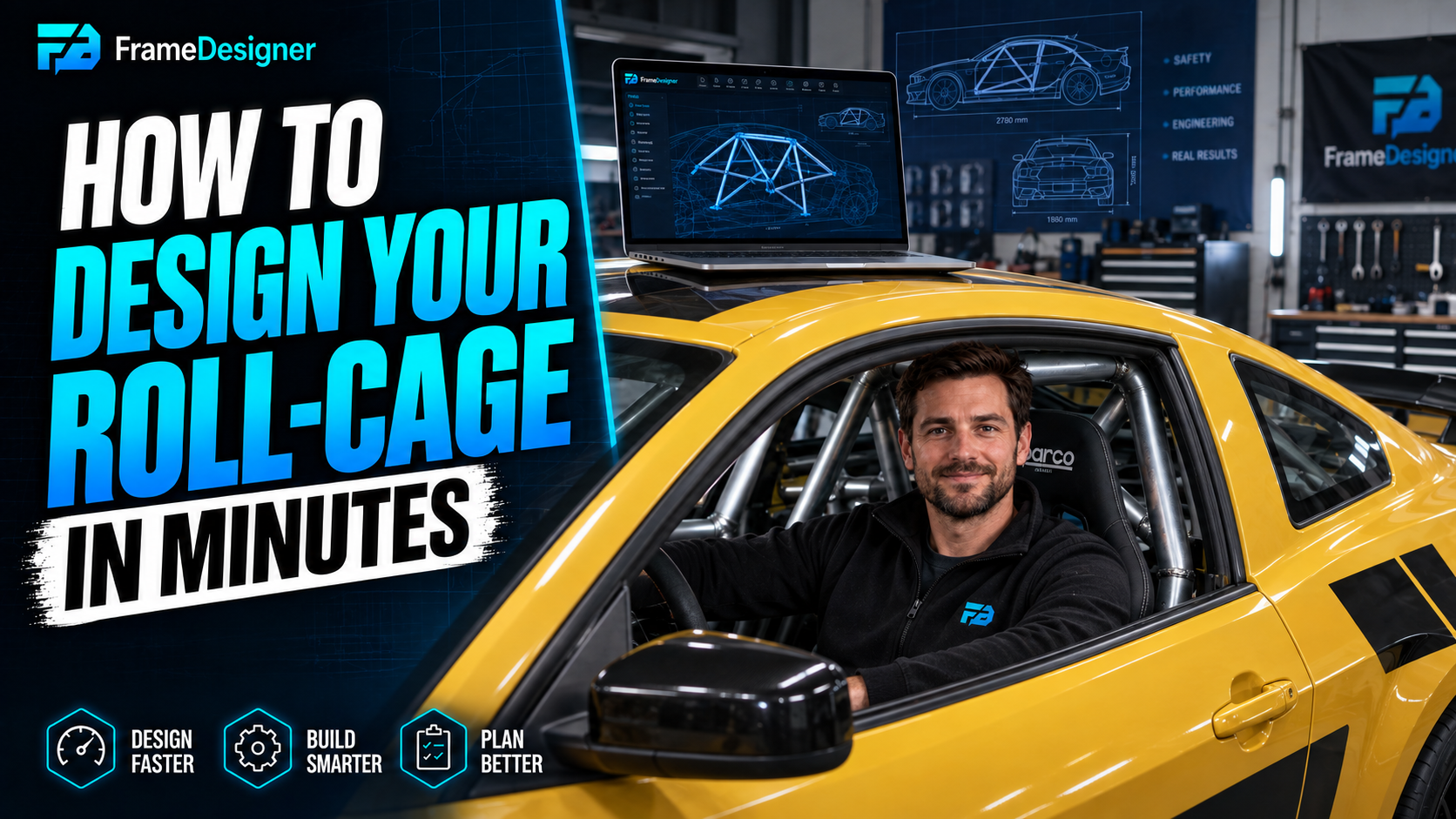
A cage has to fit a specific car, protect a specific person, and satisfy a specific rulebook. Those three fight each other, and the rulebook always wins.
So read it first. Sanctioning bodies specify tube diameter and wall, permitted materials, welding process, mandatory members, mounting-plate dimensions and clearance minimums. None of that is advisory, and a cage that fails tech is scrap metal with a lot of your weekends in it. Work from the current rulebook for your class — not a forum post, and not this page.
Material selection is mostly dictated by that rulebook. How cage tubing gets specified covers DOM against chromoly, why ERW is usually banned, and why wall thickness gets measured on the outside of a bend. I won't repeat it here. The short version for a first build: mild steel DOM, slightly above minimum wall, keep the mill cert.
The occupant comes before the car
The cage exists to protect a person, so start with the person.
With the reference vehicle loaded, establish the seat position, the driver's head position in a helmet, and the shoulder and hip positions. From those come the clearances: helmet to any tube, helmet to main hoop, and room for the occupant's arms relative to the door bars. Most rulebooks put minimums on these and they get checked with a tape at inspection.
Only then look at the shell — roof height, pillar positions, floor structure, and where there's solid metal worth mounting to.
Doing it the other way round is the classic mistake. Design to the shell, then discover the driver's helmet is 20 mm from a tube and the whole hoop has to move.
The main hoop
The main hoop is the primary member and everything else is positioned relative to it. Up one side of the occupant, across behind or above the head, down the other side.
Three things:
- One continuous bent tube where the rules permit it, so there's no weld in the highly loaded upper corners.
- Bend radius has to suit a die you own. A hoop is two bends in one member and the CLR comes from your tooling, not your preference.
- It has to clear the roof and the occupant simultaneously, which in a low car is the single tightest packaging problem on the structure.
The hoop is symmetric about the vehicle centerline, so turn symmetry on the moment it exists.
Forward structure and door bars
A-pillar bars run forward from the top of the hoop following the windscreen pillars. They have to clear the glass, hug the shell closely enough to be practical, and still leave a gap you can climb through.
Door bars are the most constrained members in the cage. They need to sit at a height that protects the occupant's torso, leave room for an arm, and still let a human being get in and out. On a car that also gets driven on the road, this one trade-off usually dictates the final design more than anything else does.
Rear stays run back from the hoop to mounting points at the rear, triangulating it so it can't fold rearward.
Mounts carry everything
A cage is only as good as what it's bolted or welded to. Mounting plates have to land on structure that can carry load — sills, floor rails, suspension mounting areas. Not unsupported floor pan, however convenient the position looks in the model.
Most rulebooks specify minimum plate area and thickness. Design the plate positions in the model, check them against the reference vehicle's real structure, and then confirm you can physically get a torch to all four sides of each one. That last check gets skipped and it's the one that produces a plate welded on three sides.
Build order matters more here
More than anywhere else in this series, because the structure progressively encloses itself.
Once the main hoop and A-pillar bars are in, access to the joints between them is limited. Once the door bars go in, some welds stop being awkward and become physically unreachable. Follow the fabrication order out of the model; where it proposes a sequence there's normally an access reason sitting behind it.
And the standing caveat, with more weight than usual: a roll cage is a life-safety structure. Design tools get the geometry right. Material certification, weld quality, rulebook compliance and inspection by qualified people are not optional and are not something software can do for you.
Comments
Loading comments…