
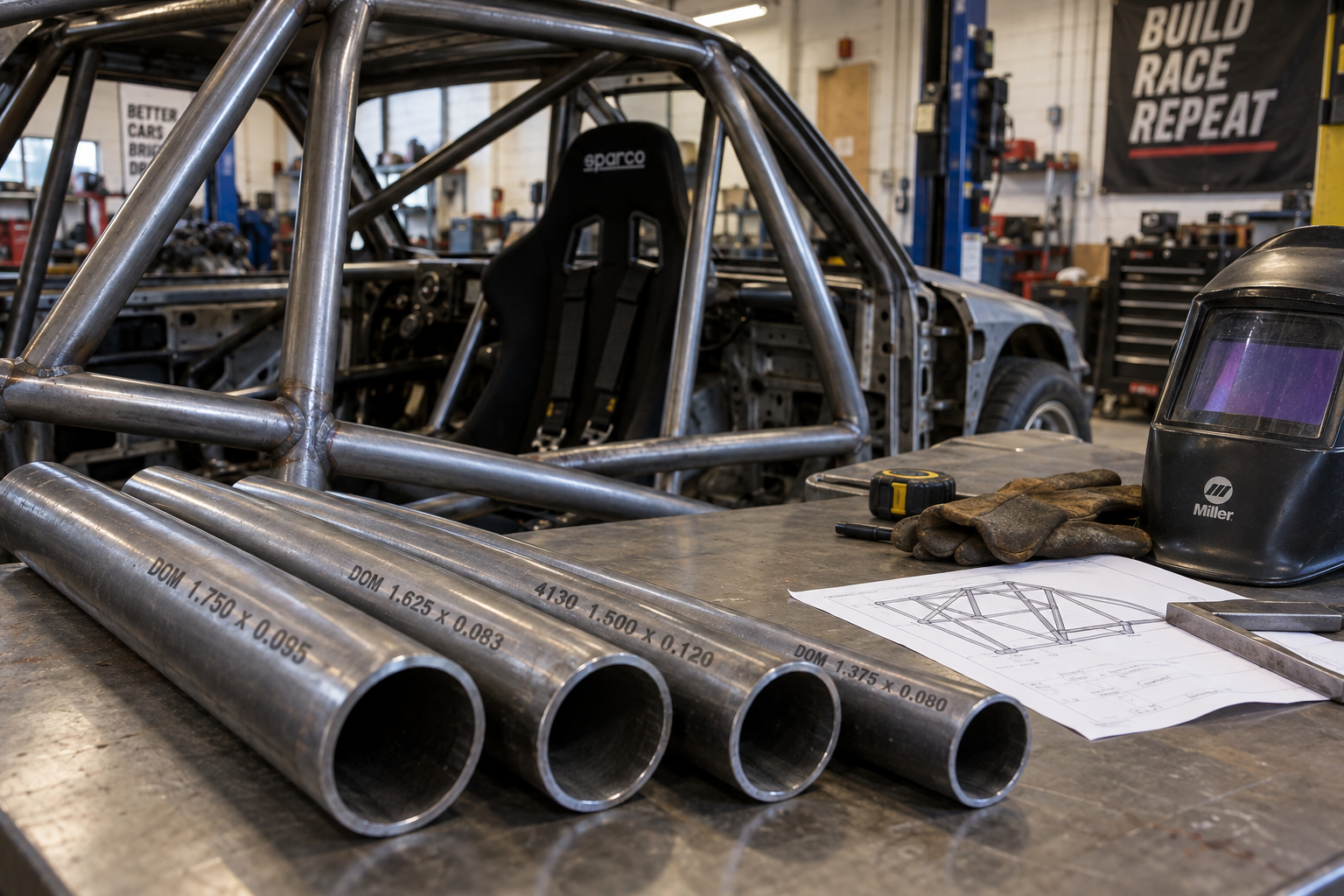
Ask a forum what tubing to use for a cage and you'll get nine confident answers that contradict each other. Some of that is legitimate — the right spec genuinely differs between sanctioning bodies, weight classes and vehicle types. A lot of it is numbers that were correct in 2011 being repeated as though rulebooks don't change.
What follows is how the requirements are structured, so you can open your own rulebook and know what you're reading. It is not a substitute for that rulebook. Treat every figure below as an illustration of a pattern, not as a spec for your car.
Everything is indexed to something
Every sanctioning body ties minimum tube size to one variable. Work out which one applies to you and most of the confusion evaporates.
Weight is the index in most road racing. Heavier car, bigger diameter or thicker wall, with weight normally taken as raced minus driver, fuel and ballast. A light car might start somewhere around 1.375" OD × 0.080" wall and step up through several bands. SCCA's GCR and NASA's CCR both work this way.
Performance is the index in drag racing. NHRA triggers requirements off elapsed time and trap speed — cross a threshold and a more demanding cage spec applies, usually along with an SFI certification requirement and a recertification interval. The thresholds move. Check the current rulebook, not the one in your glovebox.
Class is the index in a lot of other series: one fixed spec per class regardless of the individual car.
FIA Appendix J Article 253 works in metric, with main hoops commonly around 45 × 2.5 mm and secondary members around 40 × 2.0 mm. Builders in imperial countries like to approximate those. An approximation is not compliance. If the rulebook is metric, buy metric tube — 1.75" × 0.095" is not 45 × 2.5 mm and a scrutineer with a caliper will tell you so.
Why chromoly gets a thinner wall
Rulebooks that allow both mild steel and alloy steel nearly always permit a thinner wall in the alloy. A drag spec might call for 1.625" at 0.120" in mild steel but let you run 0.083" in 4130.
The reason is unremarkable: normalized 4130 runs somewhere around 95–100 ksi ultimate against roughly 70–80 for 1026 DOM, so less material does the same job. Across a full cage the saving is real — usually quoted in the 20–30 kg range.
The costs get mentioned less:
- Bodies that permit chromoly generally require TIG. MIG is not accepted. If you don't TIG, the decision is already made.
- Thin wall is less forgiving. A 0.083" joint punishes a fit-up you'd get away with in 0.120".
- It costs substantially more per foot, and fewer suppliers stock it with certification.
- Several rulebooks prohibit mixing mild and alloy steel in one cage. So it's a whole-structure decision, not a per-member one.
For most garage builds, mild steel is the answer. Unless your class specifically pays you for the weight, DOM is cheaper, more forgiving, easier to source with paperwork, and the weight penalty matters far less than a cage that's actually well made. I'd rather inspect a tidy 0.120" mild steel cage than a nervous 0.083" chromoly one. The pattern that produces the nervous one is predictable enough to name: somebody reads that chromoly saves 25 kg, buys chromoly, discovers partway through that thin wall is a different welding problem than they'd been practising on, and finishes the cage anyway because the material is already cut. The 25 kg was real. So is the fact that every joint in that structure was welded at the edge of their ability rather than comfortably inside it, and a cage is not the component to be learning on.
DOM, seamless, and why ERW usually isn't allowed
Three manufacturing routes come up, and scrutineers care about the difference.
DOM — drawn over mandrel — starts life as welded tube and then gets cold drawn. The drawing works the seam and leaves you consistent wall and predictable mechanicals. It's the workhorse.
Seamless has no seam at all. Acceptable anywhere DOM is, and it's how most 4130 arrives.
ERW — electric resistance welded, not subsequently drawn. Cheap, everywhere, looser tolerances, less predictable seam, and flatly prohibited for cage work in most rulebooks. There's a habit of buying oversized ERW to guarantee passing a wall check. It's heavy, it's still not legal, and it misses the point of the rule.
Wall gets measured where it's thinnest
Here's the detail that catches people at tech. Inspectors may sonic-check wall thickness, and the thinnest point on a bent member is on the outside of the bend, where the material stretched.
So a member bought exactly at minimum wall can measure under minimum after bending and fail, despite being nominally correct when you ordered it. Mill tolerance can push the same direction. That's the real argument for buying slightly above the minimum rather than exactly at it — not belt-and-braces paranoia, just knowing where the caliper goes.
A lot of rulebooks also require inspection holes so the wall can be read directly. Put them where someone can actually get to them.
Diameter or wall?
Within whatever your rules allow, there's a real engineering question about where to spend material.
Bending stiffness scales with diameter far harder than with wall. That's why a bigger, thinner tube often beats a smaller, thicker one at the same mass. 1.75" × 0.095" weighs slightly less than 1.5" × 0.120" and is stiffer in bending.
Diameter isn't free, though. Big tube eats interior space, and in a small car that bites hard around the occupant and the door apertures — the difference between a cage you can climb into and one you have to be poured into. It also wants bigger dies, which is money.
Before you cut anything
- Get the current rulebook for your class, from the sanctioning body, this season.
- Work out which index applies: weight, performance or class.
- Check whether alloy steel is permitted, and what welding process that triggers.
- Check whether mixing materials is prohibited.
- Buy DOM or seamless. Not ERW, unless your rules explicitly say otherwise.
- Go slightly above minimum wall so you survive post-bend measurement.
- Keep the mill cert. Scrutineers ask.
- Confirm your dies produce a CLR you can design around.
- Call a tech inspector before cutting. They would much rather have that conversation than the other one.
Design software will tell you what geometry to build. It won't tell you whether it passes tech. That part is yours, and it's a much better problem to solve before the first cut than after the last weld.
Comments
Loading comments…