
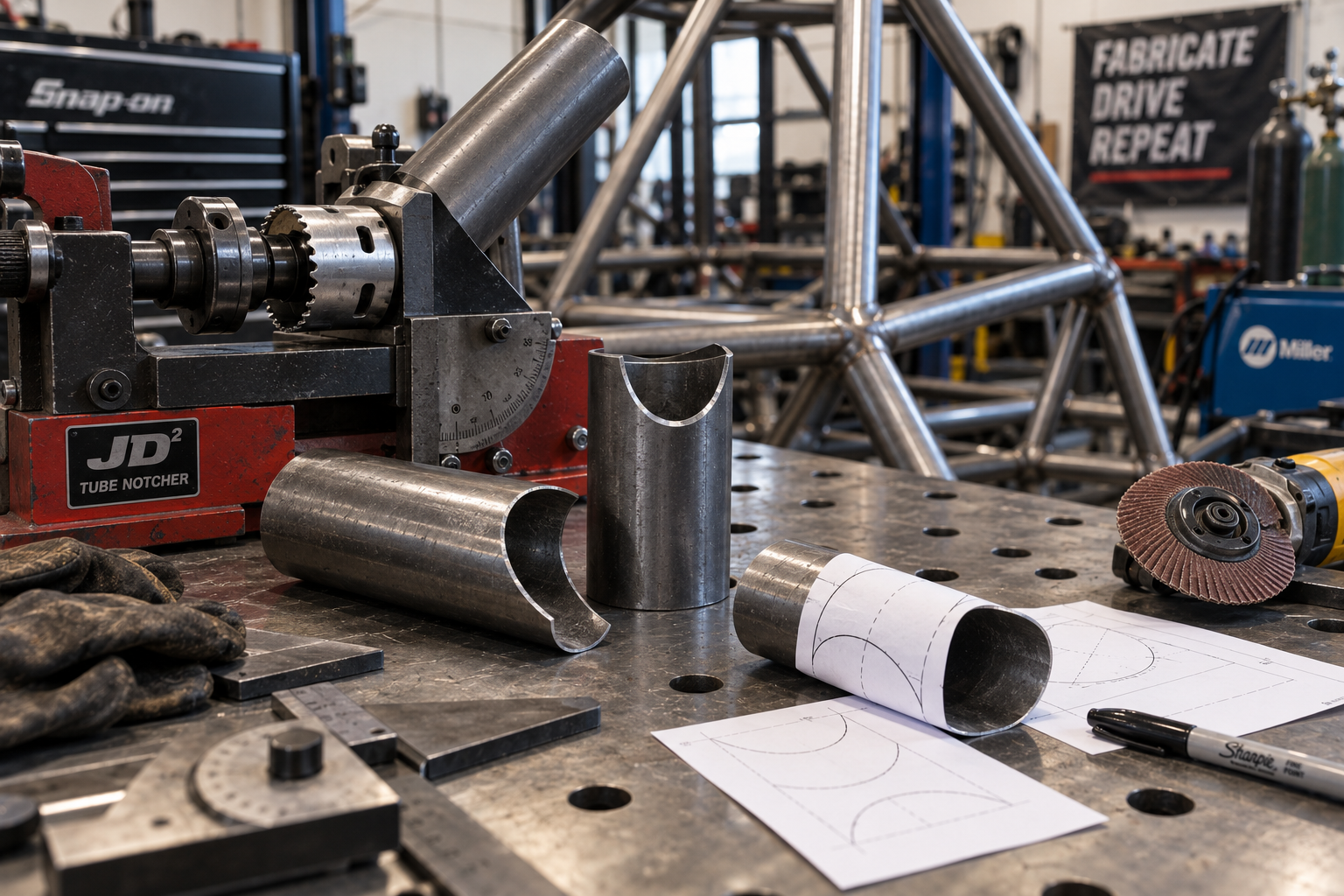
Four tubes land on one rail, and every one of those ends has to wrap around something round.
Notching is how you do it. Coping, fishmouthing, saddling — the word depends on who taught you. On a perpendicular joint the shape you're cutting is a half-round. Tip the joint over and that half-round stretches into an ellipse. Tip it far enough, or land it on a tube that's already bent, or bring three members into the same corner, and the curve stops being anything you can lay out with a compass.
The reason to care isn't appearance. It's what a sloppy notch does to the weld. Full contact around the perimeter means your bead is joining two surfaces that are already touching. A notch sitting 2 mm off on one side means you're bridging that gap with filler — more heat into the joint, a wider heat-affected zone, more pull, and a bead doing structural work nobody sized it for. You can see it on a cut-and-etch. You can also see it in a frame that fought you across every joint and still ended up out of square.
What the options actually cost you
| Method | Money | Time per end | Where it gives up |
|---|---|---|---|
| Template + angle grinder | You own it already | 5–15 min | Repeatability |
| Hole-saw notcher | $200–$600 plus saws | 1–3 min | Shallow angles |
| Mill + end mill | Mill access | 10–20 min, mostly setup | Throughput |
| CNC plasma, rotary axis | $25k+ or job shop | Seconds | Edge quality varies |
| Laser tube bureau | Per part | Not your problem | Minimum order economics |
A grinder and a piece of paper
Everybody ends up here eventually, whatever else is in the shop.
You print the flat pattern of the intersection, wrap it on the tube, scribe around it, then cut to the line with a thin cut-off wheel and clean up with a 60-grit flap disc. The cutting is the easy half. The template is the part that decides whether it fits, because that flat shape changes with your tube diameter, the host diameter, and the joint angle — change any one and the old template is scrap paper.
FrameDesigner's unfolded Notch 1 and Notch 2 views exist for this. Print at 1:1, wrap, scribe.
And print at 100%. Not "fit to page." Fit-to-page silently rescales by a few percent and you will not notice until four tubes are short. Put calipers on the printed scale bar before you wrap anything — it takes ten seconds and I have seen people lose an afternoon to skipping it.
Where this method wins: there's no angle a grinder can't reach. Bent host, three-way intersection, something you have to cut in place after the frame is tacked. A template and a steady hand is often the only option that exists outside a CNC shop.
Where it loses: two "identical" notches cut by hand aren't identical. On a cage with forty members that scatter stacks up, and you spend it back as gap at the joints. The compounding is the part that gets underestimated — one notch half a millimetre deep on one side is nothing, and you'd never pick it up on a single joint, but forty of them in the same structure all pulling slightly differently is how a frame ends up needing persuasion to go together at all. The tell is when you find yourself reaching for a clamp to get a joint to close. That clamp is holding a stack of small errors, and the moment you weld it the stack is locked in, to come back out as distortion when the frame leaves the table.
Hole-saw notchers
This is what most working shops use, and for a first chassis it's the right answer.
The trick is almost too simple to explain. You run a hole saw whose diameter matches the parent tube into the end of the tube you're notching, at the joint angle, on a jig holding the two in the right relationship. Because the cutter diameter equals the host diameter, the cut it leaves is the intersection curve. Geometry does the work.
Entry-level bench units sit at the bottom end of a few hundred dollars. A JD2 Notchmaster or a Mittler Bros unit costs more, and most of what the money buys is rigidity, which turns out to be the thing that matters. Check current pricing before you budget — this end of the market moves.
Things that separate a good notch from a destroyed $30 saw:
- Slow. Bi-metal hole saws in DOM want low RPM and firm continuous feed. Spin them fast and the teeth overheat and dull, and once they're dull you're generating heat rather than chips.
- Cutting fluid. Dark cutting oil on anything above thin wall extends saw life dramatically — enough that running dry is false economy on the first cut.
- Size the saw to the parent tube OD. People get this backwards once and only once.
- Clear the slug. Chips packed in the gullets is the fastest way to ruin a cutter.
- Rigidity. Any flex in the jig arrives as slop in the notch, one-for-one.
The wall you hit is shallow angles. As the joint gets more acute the saw is cutting a longer and longer ellipse with all its contact on one side, and it starts to walk. Bench notchers are typically rated to 50 or 60° off perpendicular, and the rating is optimistic — the last ten degrees of any notcher's range is where cut quality and saw life both fall away. Past that you're back to paper, or you're on a machine.
Mill and end mill
Clamp the tube at the joint angle, cut the profile with an end mill, and you get a better notch than any hole saw will give you. No saw deflection, finish is weld-ready without dressing, and thin wall and stainless behave instead of chattering.
You pay in setup. Every angle is a fresh indicate-and-clamp, and the setup swamps the cut time. For a handful of joints that will be visible, or for 0.049" wall that a hole saw would just dent, it's worth it. For a whole cage it isn't.
CNC plasma on a rotary axis
A torch on a gantry with a chuck that spins the tube. The controller unwraps the intersection into a torch path and the tube rotates underneath while it traces. A Bend-Tech Dragon is the one most small shops have actually seen; it's tens of thousands of dollars, which places it on the far side of a real decision.
What you buy is indifference to geometry. Perpendicular, acute, compound, bent host, four tubes converging on one point — the machine does not care, and it does it in seconds.
Quality is the contested part. A dialed-in machine gives you a smooth, nearly dross-free cut you can weld as-is. A badly set-up one gives you dross, an inconsistent bevel through the wall, and more cleanup than the hole saw you were trying to avoid. Plasma also puts a taper on the cut edge by nature — on 0.065" wall nobody notices, on 0.120" you will.
Laser, by someone else
A tube laser cuts the notch, the holes and the end length in one operation from one file, with edge quality nothing else on this list matches and no taper worth discussing.
Nobody puts one in a garage. What makes it relevant is that laser tube cutting sells as a bureau service, and once you're building the same frame more than two or three times the per-part price starts competing well against the hours of notching it deletes. The economics flip at repeat production, not at one-offs.
So, what to buy
A bench notcher and a grinder with templates for the joints the notcher can't reach. That covers a first cage, a second cage, and most of what comes after.
Move up when something specific forces you: a mill when the material or the cosmetics demand it, CNC plasma when you're cutting so many joints that setup time dominates everything else, a laser bureau when you're on frame number four.
One thing that's true of all of them. Every method here needs the same four inputs — joint angle, parent tube OD, cut length after material comes off, and for templates or CNC the unwrapped profile itself. Get those wrong and an expensive machine produces a very accurate version of the wrong part.
Which is the real argument for not treating the model and the frame as two separate projects. Move one joint and the angle changes; the angle changes the notch; the notch changes the cut length; the cut length changes the flat pattern. Chase that chain by hand across forty members and you won't get all forty right. That's the whole reason fabrication-aware tools spit out notch geometry per member instead of leaving you to derive it at 11pm the night before you order steel.
Comments
Loading comments…