
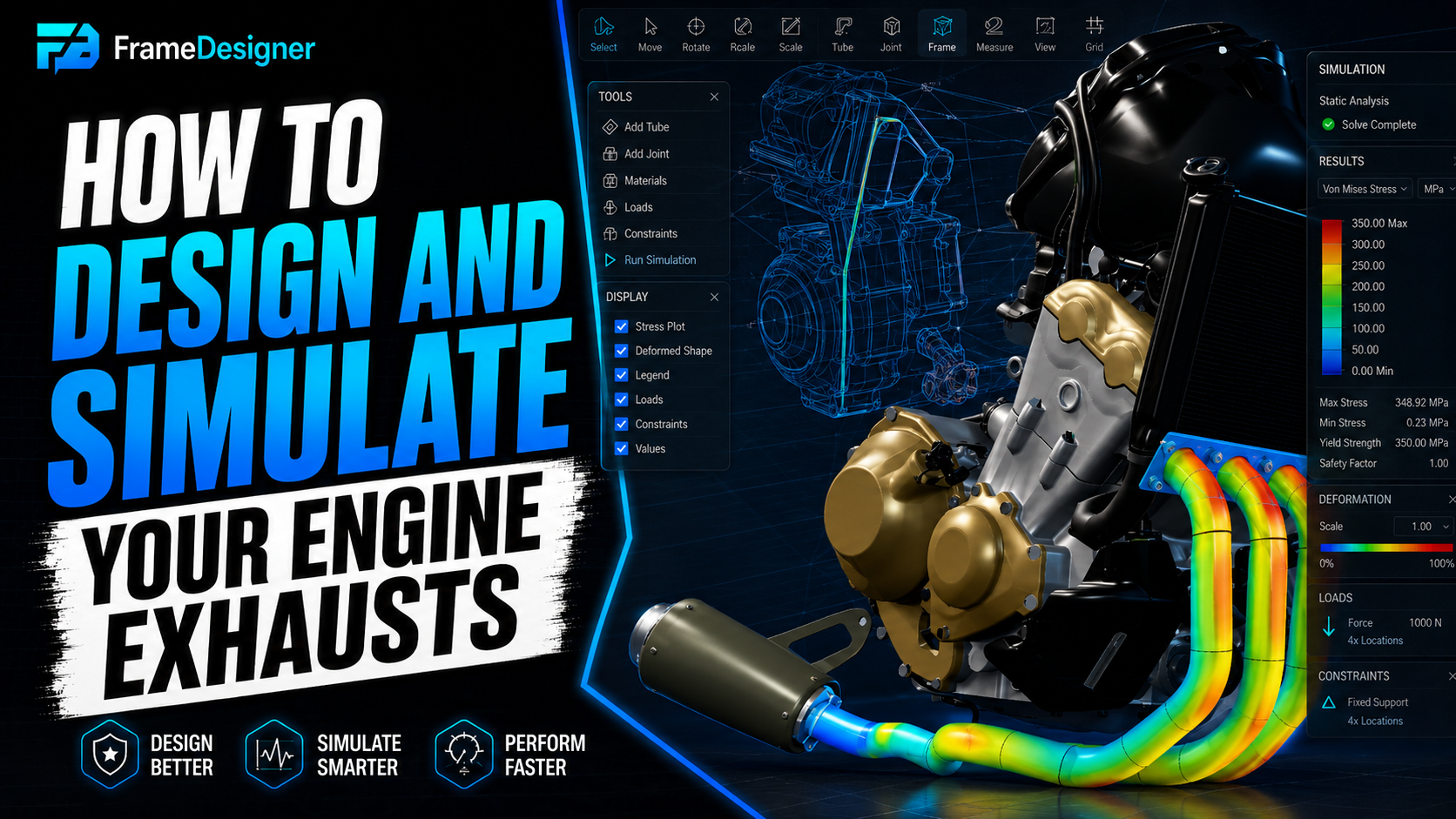
Headers are the densest packaging problem in the whole workflow. Four or more tubes leave a space the size of a shoebox, have to arrive at one point, have to be equal length, and have to do it inside a volume that's already full of engine, chassis, steering and bodywork. Then they get hot and grow.
Start at the ports
The flange is where this begins, and it's the one thing you cannot correct downstream. Exhaust ports sit at fixed positions on the head, with fixed spacing, at fixed angles, and every primary starts from one of them.
Set the port positions accurately against the engine reference model before routing anything. A flange that doesn't match the head is not fixable by adjusting tube — you cut a new flange.
Record the port angle as well as the position. Ports rarely point straight out, and the direction a port faces largely determines the first 50 mm of that primary whether you like it or not.
Why equal length is hard
Primaries get designed to equal length so pulses from different cylinders reach the collector with consistent timing.
The difficulty is purely geometric. The ports sit at different distances from wherever the collector ends up, so the naturally shortest primary has to be artificially lengthened to match the longest. That extra length has to go somewhere, and the somewhere is already occupied.
Which is where the characteristic look of a good header comes from: inner primaries taking a longer, more convoluted route than any straight-line reasoning would suggest. People assume that's styling. It's the only place the length would fit.
One thing to be precise about: when you specify a primary length you mean the centerline path from port face to collector entry, including the arc through every bend. Developed length again. Estimating header lengths from straight-line distance between two points will have you cutting tube that's 30 mm short, four times.
Bends, in a space that's already full
Practical constraints, roughly in the order they bite:
- Keep bends as gentle as packaging allows. Tight bends restrict flow and thin the outer wall.
- Leave a straight section at the port. Bending right at the flange is hard to fabricate and worse to weld cleanly — you can't get a torch in there.
- Watch tube-to-tube clearance. Primaries that touch will chafe and crack. They need room for thermal growth, and they need enough space that every weld is physically reachable, which is a bigger number than the clearance itself.
- Respect the collector approach angle. Tubes should arrive heading roughly the same direction. One primary entering sideways disrupts flow for every other cylinder.
The collector
Two questions: how gradually do the tubes converge, and do they meet in a symmetric arrangement?
A long gradual merge flows better than an abrupt one. A symmetric arrangement means no cylinder is disadvantaged. Both of them want space you haven't got, which is the recurring theme of header design and the reason nobody's header looks like the one in the textbook.
Heat is a design input
Headers run hot enough to destroy things a frame member would happily sit against. Everything nearby needs deliberate clearance, not whatever clearance happens to be left:
- Wiring, hoses and fuel lines want generous separation or a shield, and 10 mm of air is not separation.
- Steering components and brake lines need room and usually protection too.
- The tubes themselves grow when hot, so every clearance you measured cold gets smaller in use.
- Anything bolted to the chassis in the neighbourhood will see radiated heat whether or not it's in the way.
Because the reference model shows you the surrounding components, this is exactly the check the software is good for. Walk the routed header against everything in the bay before you cut a single tube.
Fabrication
Header primaries produce the nastiest fabrication data in the whole workflow. Several bends per tube, non-trivial clocking on every one of them, and tight tolerances because each tube has to meet a collector and a flange at the same time.
Read the per-member bend sequence carefully, and take the fabrication order seriously — more seriously here than anywhere else. With headers the sequence really is constraining: once two primaries are welded to the collector, the room you needed to manipulate the third one is gone, and there's no recovering it without cutting one back off.
Simulating the routing first is worth the time on a part this fiddly. It's much cheaper to find the interference on screen than to find it with four tubes already tacked.
Comments
Loading comments…